KNUST College of Health Sciences Opens 3rd Biennial Postgraduate Conference on Responsible Research, Innovation and Ethical AI

The College of Health Sciences (CHS) of the Kwame Nkrumah University of Science and Technology (KNUST) has officially commenced its 3rd Biennial Postgraduate Conference, bringing together postgraduate students, researchers, clinicians, academics, innovators, policymakers, and industry stakeholders to deliberate on the future of healthcare and scientific advancement.
The two-day conference, which began on 10th June 2026, is being held under the theme: “Advancing Health Through Responsible Research, Innovation, and Ethical Artificial Intelligence.”
The conference serves as a platform for showcasing cutting-edge research, fostering interdisciplinary collaboration, and promoting responsible scientific innovation aimed at improving health outcomes and strengthening healthcare systems.
In his opening remarks, the Provost of the College of Health Sciences, Prof. Christian Agyare, emphasized the significance of the conference in highlighting the remarkable research, innovations, and scholarly contributions of postgraduate students and researchers.
He noted that these emerging scholars continue to shape the future of healthcare, science, and academia through impactful research and innovation. Prof. Agyare further expressed optimism about the growing role of innovation and emerging technologies, particularly Artificial Intelligence (AI), in transforming healthcare delivery and research landscapes globally.
“The conference serves as an important platform to showcase the remarkable research, innovations, and scholarly contributions of our postgraduate students and researchers, who continue to shape the future of healthcare, science, and academia,” he stated.

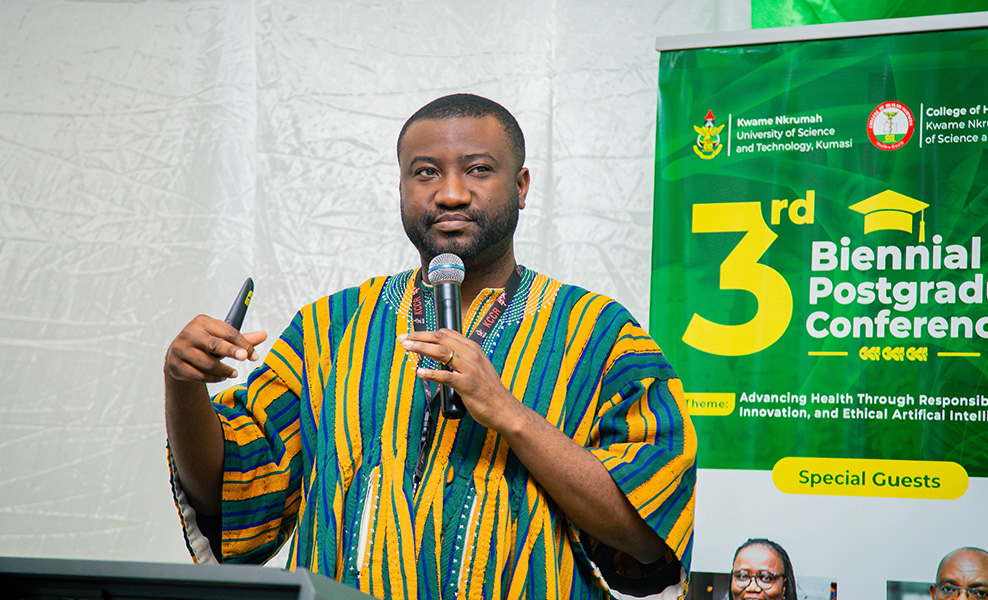
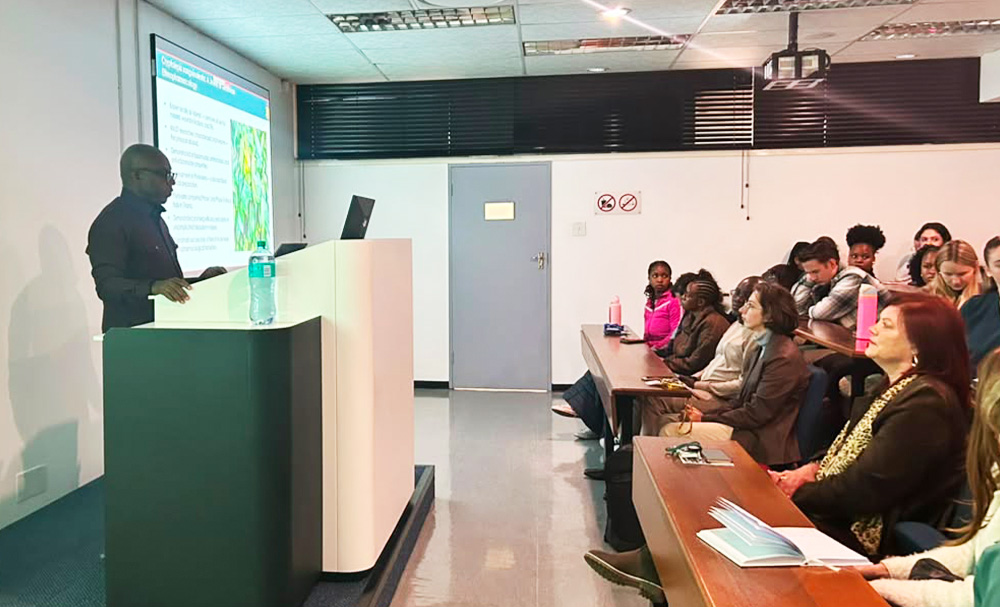
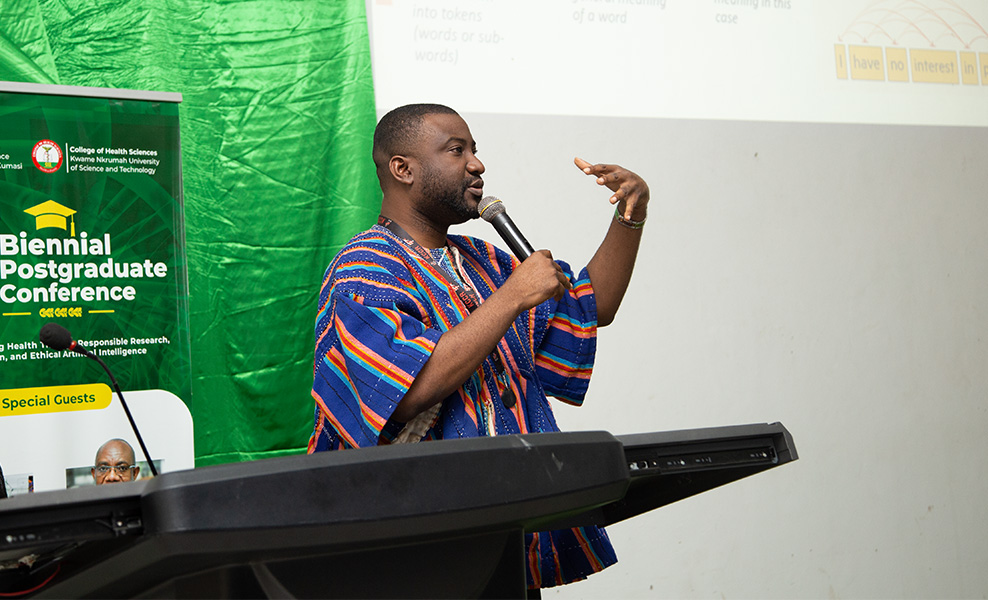
The conference opened with a pre-workshop session titled “Beyond ChatGPT: Harnessing Artificial Intelligence for Modern Research,” delivered by Dr. Prince Ebenezer Adjei, Lecturer at the Department of Computer Engineering, KNUST, and Research Fellow at KCCR-GHID.
In an engaging and insightful presentation, Dr. Adjei explored the transformative role of Artificial Intelligence across the entire research lifecycle—from problem identification and literature review to data analysis, manuscript development, and grant proposal writing. Participants gained practical insights into AI technologies, including machine learning, deep learning, generative AI, and large language models, as well as their strengths, limitations, and ethical implications.
Dr. Adjei also introduced participants to emerging global and African AI ecosystems, demonstrated advanced AI-powered research tools, and highlighted effective prompt engineering techniques to enhance research productivity. Stressing the need for responsible AI adoption, he encouraged researchers to critically evaluate AI-generated outputs, address issues of bias and privacy, and embrace AI as a tool that augments rather than replaces human expertise.
Delivering the keynote address, Prof. Jerry John Kponyo, Director of the KNUST Office of Grants and Research, reflected on the future of healthcare systems in the era of emerging technologies. He examined critical challenges confronting Ghana’s healthcare ecosystem and discussed how impactful research and responsible innovation can provide sustainable solutions.
Prof. Kponyo presented practical examples of technological transformations within healthcare and research environments while addressing key ethical concerns associated with emerging technologies. He further explored the prospects and challenges of Artificial Intelligence in healthcare and underscored the crucial role that young researchers must play in advancing scientific discovery and securing the nation’s health future.

Chairperson of the Conference Organising Committee, Prof. Alexander Yaw Debrah, highlighted the rapid technological advancements that are reshaping healthcare globally. He observed that innovations in artificial intelligence, genomics, digital health technologies, and data science are revolutionizing disease diagnosis, therapy development, outbreak prediction, and patient care.
According to him, these advancements present significant opportunities to transform healthcare delivery and strengthen health systems, particularly in low- and middle-income countries such as Ghana.
“The developments we are witnessing today present enormous opportunities to transform healthcare delivery and strengthen health systems, particularly within low- and middle-income countries,” he noted.
As the conference continues, participants will engage in scientific presentations, research exhibitions, panel discussions, and networking sessions designed to foster collaboration and generate innovative solutions to contemporary health challenges.

The 3rd Biennial Postgraduate Conference reaffirms the College of Health Sciences’ commitment to promoting excellence in research, innovation, and ethical scientific practice while preparing the next generation of researchers and healthcare leaders to address pressing national and global health challenges.